
Apex Fence Company installs commercial chain link fencing for general contractors, developers, facility managers, and municipalities throughout metro Atlanta. Distribution centers, industrial perimeters, utility facilities, school campuses, athletic complexes, and construction site enclosures — commercial chain link fencing is a volume product that punishes specification shortcuts and rewards crews who know the difference between a fence that meets the spec sheet and one that actually performs at scale. Apex has been building commercial chain link across Cherokee, Cobb, Fulton, Gwinnett, Bartow, and Forsyth counties since 2005, installing over 250,000 linear feet of fence annually across residential and commercial applications combined.
Why General Contractors & Facility Owners Choose Apex for Commercial Chain Link
Commercial chain link fencing is a subcontract line item that general contractors need bid-ready, priced accurately off the plans, and installed on schedule without creating problems for the broader project timeline. Apex operates specifically to meet those requirements. We perform digital takeoffs from submitted plans and specifications using web-based estimating tools — no site visit required for the bid phase, no scheduling delays waiting for an estimator to free up. Proposals come back with the material quantities, framework specifications, and labor scope documented against the submitted documents. What you bid is what we build.
The volume Apex installs annually — 250,000+ linear feet across 1,000+ projects — means our crews and material supply chains operate at commercial scale, not at residential volume with occasional commercial work added in. A 2,000-foot industrial perimeter fence and a 400-foot school campus enclosure both get crews sized for the scope, materials sourced to spec, and installation sequenced to the project schedule. Forty to fifty professional installers on staff means we can mobilize at the scale commercial projects require without subcontracting the work out. Every commercial chain link installation carries a 5-year workmanship warranty.
Commercial Chain Link Fencing Options for Atlanta, Georgia Projects
Commercial chain link specifications vary significantly by application. A construction site perimeter, a utility substation enclosure, and a municipal athletic facility all call for different fabric gauge, framework sizing, post embedment, and top treatment. Apex works from the submitted spec sheet or advises on the correct specification when the project documents leave it to the contractor’s judgment. Here is how commercial chain link specification breaks down across the applications Apex handles most in metro Atlanta.
Fabric Gauge & Mesh Specification
Fabric is where commercial chain link diverges most clearly from residential product. The wire gauge and zinc coating weight determine how the fence performs over years of exposure, and commercial specifications typically call for heavier product than the residential baseline:
- 9 gauge fabric: The standard commercial specification for most perimeter and security applications. Produces a stiffer, more rigid mesh than residential 11 gauge — the difference is tactile and visible side by side. Resists deformation under impact and maintains tension across longer runs between terminal posts
- 11 gauge fabric: Appropriate on lower-security commercial applications — construction site enclosures, temporary perimeter fencing, light-duty utility enclosures where the fence is a boundary marker rather than a security barrier
- 6 gauge and heavier: Specified on high-security industrial applications, correctional facilities, and perimeters where the fabric needs to resist sustained cutting or climbing attempts. Less common in metro Atlanta’s general commercial market but available and installed by Apex when the project specification calls for it
- Mesh opening size: Standard commercial chain link uses 2-inch mesh. Smaller 1-3/4 inch mesh provides increased climb resistance and is specified on applications where access control is the primary security function
- ASTM A392 Class 1 galvanizing: The correct zinc coating specification for commercial chain link — 0.80 oz/sq ft minimum. Class 2 is a residential-grade coating weight that commercial specifications should not accept. Vinyl-coated fabric over Class 1 galvanized is the appropriate specification when coating is called for
Framework Specification
Framework — posts, top rail, braces, and tension wire — is what carries the load the fabric places on the fence system. Commercial framework is sized by fence height and application, and getting the post diameter and embedment depth right at the design stage prevents the gradual lean and terminal post shift that produces fence failure on long commercial runs:
- Line posts: Sized by fence height — 2-inch OD pipe for fences up to 6 feet, 2.5-inch for 8-foot, and 3-inch or heavier for 10-foot and above. Post spacing on commercial chain link is typically 10 feet on center, with reduction to 8 feet on exposed or high-wind sites
- Terminal posts (end, corner, pull): Always larger diameter than line posts — terminal posts carry the entire tension load of the fabric run and must be sized accordingly. Undersized terminal posts are the single most common cause of commercial chain link fence failure over time
- Top rail: 1-5/8 inch OD is the standard residential specification; commercial applications at 8 feet and above typically call for 1-7/8 inch or 2-inch top rail to handle the increased fabric load and lateral pressure of taller panels
- Brace assemblies: Horizontal and diagonal bracing at every terminal post is a structural requirement, not a detail. Commercial specifications typically call for both a horizontal brace rail and a diagonal tension brace wire — the combination prevents terminal post rotation under fabric tension load
- Post embedment and concrete: Commercial post embedment depths are calculated by fence height and soil conditions. A standard rule of thumb — 1/3 of post length in the ground — is a starting point, not a specification. Terminal posts on commercial applications require larger diameter concrete footings than line posts to resist the differential load they carry
Top Treatments & Security Additions
Commercial chain link top treatments are a security specification, not an aesthetic one. What gets installed at the top of the fence depends on the security tier the application requires:
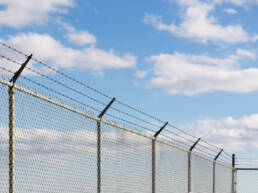
- Barbed wire: Single-strand or 3-strand barbed wire outriggers are the standard top treatment on industrial perimeters, utility enclosures, and commercial properties where deterrence of casual intrusion is the objective. Outrigger angle — vertical, 45-degree inward, or 45-degree outward — is determined by whether the primary concern is climbing in or climbing out
- Razor wire / concertina coil: A higher-security top treatment specified on applications where barbed wire is insufficient deterrence — correctional facilities, high-value industrial sites, and perimeters where the consequence of breach is significant. Razor coil is installed on top of or in lieu of barbed wire outriggers depending on the security specification
- Tension wire bottom: A bottom tension wire run below the lowest mesh opening is a standard commercial addition on perimeters where ground intrusion is a concern — prevents the fabric from being lifted from the bottom without compromising the fence’s structural system
- No top treatment: Construction site enclosures, athletic facilities, and commercial applications where the fence functions as a boundary rather than a security barrier typically specify chain link without top treatment
Commercial Chain Link Heights
Commercial chain link is installed across a wide height range depending on application and security tier:
- 4 to 6 feet: Construction site perimeters, athletic facility boundaries, school campus enclosures, light commercial boundaries. The most common height range in metro Atlanta’s general commercial market
- 8 feet: Standard industrial perimeter and utility enclosure height. Adds meaningful deterrence over 6-foot without the added framework requirements of taller installations
- 10 to 12 feet: High-security industrial perimeters, correctional-adjacent applications, and facilities where the fence height itself is a primary security component. Requires heavier framework throughout and deeper post embedment
- Custom heights: Available to project specification. Apex works from the submitted height requirement — we do not substitute standard heights when the project documents specify otherwise
Commercial Chain Link Gates
Gates on commercial chain link installations are a separate engineering scope from the fence line. Slide gates, swing gates, and cantilever gates are all installed by Apex on commercial projects, with specifications that reflect the gate’s weight, opening width, cycle frequency, and any automation requirements:
- Slide gates are the standard specification on commercial vehicle access openings — they do not require swing clearance behind the gate and accommodate the full opening width without a center post obstruction
- Cantilever slide gates — no bottom track in the driveway surface — are the preferred commercial specification where forklift traffic, heavy vehicles, or high-cycle use would damage or obstruct a track-driven system
- Gate post sizing and embedment on commercial applications are calculated for the gate’s weight and swing or slide load — not defaulted to the framework specification of the adjacent fence line
- Automation integration — slide gate operators, access control, loop detectors, safety edges — is coordinated by Apex as part of the gate installation scope on commercial projects that require it


Our Commercial Chain Link Fencing Process in Metro Atlanta
- Submit Project Documents: General contractors, project managers, and facility owners submit plans, specifications, and bid documents via our website or directly to our estimating team. For commercial chain link, that typically means a site plan with fence line delineation, linear footage, height requirements, fabric and framework specification, top treatment, and gate locations and sizes. Apex does not send estimators to commercial sites for the bid phase — we work from the documents you provide and return a proposal on the schedule the bid requires.
- Takeoff & Proposal: Apex performs a digital takeoff from the submitted documents using web-based estimating tools. We quantify linear footage by specification segment, terminal post locations, gate openings, top treatment runs, and any site-specific conditions noted in the documents. The proposal is returned with material quantities, framework specifications, and labor scope itemized against the submitted plans — structured for GC review and bid package assembly. Turnaround is aligned to the bid schedule.
- Scheduling & Site Coordination: Once the contract is awarded, Apex coordinates mobilization schedule, site access, phasing requirements, and 811 utility marking with the general contractor or project manager. Commercial chain link installations on active construction sites require sequencing against the broader project schedule — we align to those constraints and communicate proactively when site conditions affect the installation timeline. Permit requirements, if applicable, are identified and addressed at this stage.
- Installation & Project Closeout: Apex crews handle material delivery and full installation to the specifications of the submitted documents — post setting, concrete, framework, fabric installation and tensioning, top treatment, and gate hanging and hardware. No subcontractors. On commercial projects, closeout documentation including as-builts, warranty paperwork, and lien waivers is provided at project completion as required by the general contractor or owner. The 5-year workmanship warranty applies to all commercial chain link installations.
Apex operates within the commercial bid and construction process — submittals, RFIs, phased scheduling, and closeout documentation are part of how we work, not exceptions we accommodate. General contractors who need a fence subcontractor that runs like a commercial operation get one.
Commercial Chain Link Fencing Across Metro Atlanta
Apex installs commercial chain link throughout the greater Atlanta area north of I-20, with active project volume across a range of industries and facility types. The markets and applications below represent the strongest commercial chain link demand in our service footprint.
- Industrial & Distribution Facilities: Metro Atlanta’s position as a Southeast logistics hub generates consistent demand for perimeter fencing on distribution centers, warehousing facilities, and light manufacturing sites throughout the I-75, I-85, and I-285 corridors. Typical specification: 9 gauge galvanized, 8-foot height, 3-strand barbed wire top treatment, cantilever slide gates at truck access points.
- Utility & Infrastructure: Electrical substations, water treatment facilities, telecommunications infrastructure, and pipeline right-of-way enclosures throughout Cherokee, Cobb, Fulton, and Forsyth counties. Utility enclosure specifications typically call for 9 gauge fabric, 8 to 10-foot height, barbed wire or razor coil top treatment, and post embedment depths that meet utility owner standards rather than standard commercial defaults.
- Construction Site Enclosures: Temporary perimeter fencing on active commercial and residential construction sites throughout metro Atlanta. Construction site enclosures are typically 6-foot 11 gauge chain link on driven posts — no concrete, no permanent embedment — configured for rapid installation and removal as the project progresses. Apex installs and retrieves temporary enclosures on multi-phase commercial projects.
- School Campuses & Athletic Facilities: Cherokee County Schools, Cobb County Schools, and Fulton County Schools all generate commercial chain link demand for campus perimeter fencing, athletic field enclosures, and secure access boundaries. Athletic facility chain link — baseball backstops, tennis court enclosures, multi-sport perimeters — involves non-standard post spacing and fabric configurations that differ from standard perimeter installation.
- Municipal & Government Facilities: City and county facilities throughout metro Atlanta — public works yards, parks and recreation perimeters, government campus boundaries, and utility infrastructure — generate commercial chain link specification that must meet municipal procurement standards. Apex is familiar with the documentation and compliance requirements that municipal contracts carry.
- Commercial Real Estate & Mixed-Use Development: General contractors on commercial real estate projects throughout the Atlanta metro — retail developments, office parks, multifamily construction, and mixed-use sites — require fence subcontractors who can work within the GC’s construction schedule and produce the documentation their project management systems require. Apex operates that way by default.
- Cherokee & Forsyth County Industrial Corridors: Active industrial development along the Hwy 575 corridor through Canton and the GA-400 corridor through Cumming generates consistent commercial chain link demand from both new construction and facility expansion projects. Apex is based in Canton and operates in both corridors with crew and material supply chain proximity that translates to competitive mobilization timelines.
Frequently Asked Questions — Commercial Chain Link Fencing in Atlanta
The more complete the submission, the faster and more accurate the proposal. At minimum: site plan with fence line delineated, total linear footage by specification segment if the project has multiple specs, fence height, fabric gauge and mesh size, top treatment type and linear footage, gate locations with opening widths and gate type (swing, slide, cantilever), and any framework specification called out in the project documents. If the project has a written specification section for chain link fencing, include it. If the specification is open to contractor recommendation, note that and we will advise on the appropriate spec for the application. Apex does not require a site visit to produce a commercial proposal — we work from the documents.
The differences are meaningful and compound across a large installation. Commercial specifications typically call for 9 gauge fabric versus residential 11 gauge — heavier wire, stiffer mesh, better resistance to deformation and tension loss over time. Framework is heavier throughout: larger diameter line posts, heavier terminal posts sized for the tension load of long fabric runs, heavier top rail on taller applications. Post embedment depths are greater, concrete footing volumes are larger at terminal post locations, and brace assemblies are more complete. The result is a fence that maintains its geometry and tension over years of use on a commercial site rather than gradually loosening and leaning the way an underspecified fence does.
Yes — crew capacity and material supply chain are both built for commercial volume. Apex runs 40 to 50 professional installers and installs over 250,000 linear feet of fence annually. A 3,000-foot industrial perimeter is not a project that stretches our capacity or requires subcontracting the work out. We have the crew depth to mobilize at the scale commercial projects require, the material sourcing relationships to supply commercial-specification product without extended lead times, and the project management structure to coordinate with a GC’s construction schedule rather than running on a residential queue.
Yes. Temporary construction site enclosures — 6-foot chain link on driven posts, no concrete — are a regular scope item for Apex on active commercial and residential construction projects throughout metro Atlanta. We install at project start and retrieve at project completion, and on multi-phase projects we coordinate fence relocation with the construction schedule as the site footprint changes. Temporary enclosure specifications vary by jurisdiction and project type; some municipalities and general contractors have specific requirements for construction site fencing that we accommodate.
Apex is based in Canton and has completed commercial chain link installations throughout Cherokee and Forsyth counties across industrial, utility, municipal, and school campus applications. The Hwy 575 corridor through Cherokee County and the GA-400 corridor through Forsyth County are both active commercial and industrial development markets where Apex has consistent project presence. For references or examples relevant to a specific project type, contact us directly — we can point to completed work in the market and application most relevant to your project.
Submit Your Commercial Chain Link Project to Apex Fence Company
Apex Fence Company has been installing commercial chain link fencing across metro Atlanta since 2005 — industrial perimeters, utility enclosures, school campuses, construction site enclosures, and municipal facilities built to specification, on schedule, and backed by a 5-year workmanship warranty. We work from your documents, not from a site visit, and return proposals structured for GC bid package review. Request your free estimate or call (770) 425-0048.